By Seth Daniel
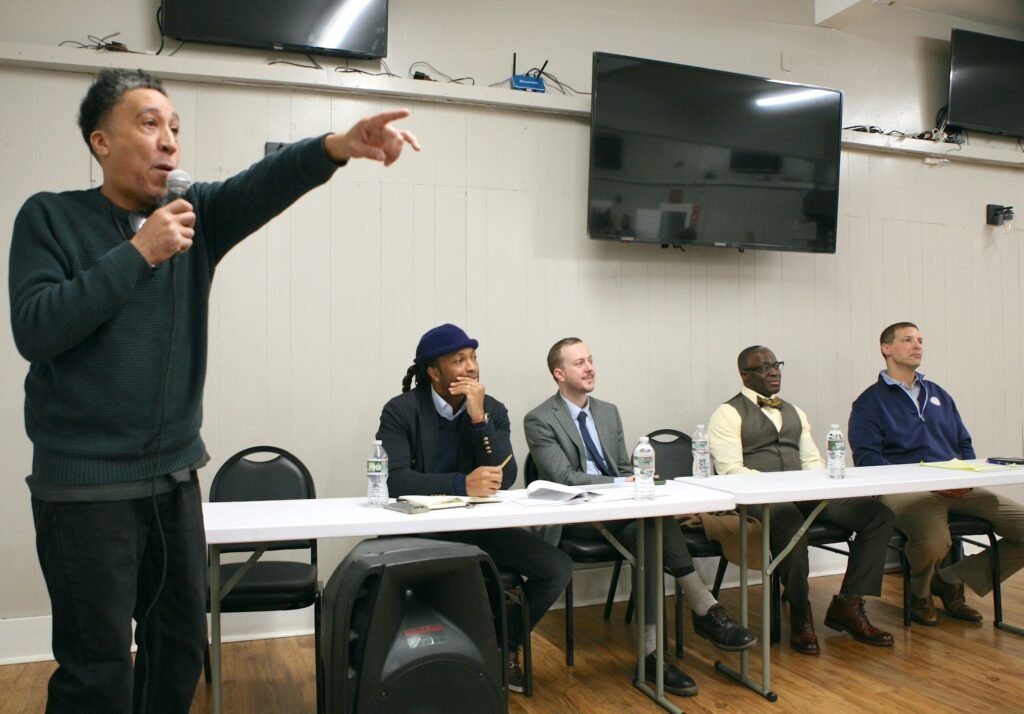
A room filled with elected officials, activists, union officials and residents vented about the slow pace of reform measures within the Boston Police Department (BPD) during a forum held last Saturday afternoon at the Dorchester headquarters of the Metropolitan Association of Minority Law Enforcement Officers (MAMLEO) organization.
The three-hour meeting largely focused on post-2020 efforts to strengthen civilian review of alleged police misconduct through the city’s Office of Police Accountability and Transparency (OPAT), set up under former Mayor Martin J. Walsh. Critics say that the panel’s recommendations are too often ignored by the BPD’s current Commissioner Michael Cox.
OPAT is an independent city agency tasked with police oversight that reviews civilian complaints and investigates everything from police misconduct to negligence of duty to wrongful terminations. A similar state agency called the Police Officer Standards and Training (POST) Commission also exists.
Saturday’s event was moderated by Roxbury activist Jamarhl Crawford of Blackstonian, who served on a task force that advised on the creation of OPAT.
“We need to get police reform back in the spotlight,” said Crawford. “Police reform was the hot-button issue and now they have elevated housing and education and rent being too high and those issues have taken precedence, and we’ve lost some ‘Umph.’ We need to get it back to the front again.”
Attorney Sam Harold, the chairman of the Civilian Review Board within OPAT, and one of the panelists on Saturday, said, “What we want to happen is we want our findings to be final. We want our recommendations to have some staying power. We send them to [Cox], and we don’t hear back for a year, and they say they don’t agree with it and want to do their own investigation.”
Boston Police Patrolmen’s Association (BPPA) President Larry Calderone also spoke on the panel alongside Sgt. Det. Eddy Crispin, also a state Police Officer Standards and Training (POST) commissioner, and OPAT Executive Director Evandro Carvalho.
Cox and OPAT Commissioner Anthony Fugate were invited but did not attend.
Carvalho, a former state representative from Dorchester (pictured below), indicated his own frustrations with the pace of progress since his appointment to run the OPAT office by Mayor Wu in 2024. Much of his focus, he said, was on hiring staff, getting subpoena powers in use, and reviewing 137 complaints.
Read full article on Dorchester Reporter

“It is challenging getting this off the ground,” Carvalho said. “A lot of what we’re doing is getting the momentum going.”
A key frustration is that police officers summoned for OPAT investigations often don’t show up for hearings and aren’t required to. Black residents make up 22 percent of the population while accounting for 45 percent of all arrests and 46 percent of OPAT complaints, according to Carvalho. He would like to use subpoenas to compel officers to testify but said even that power is limited.
“I’m just implementing the work. Are there gaps? There are,” he said. “Some of the authority gaps that are coming up here – that’s law making…I’m trying to execute what we have.”
Calderone interjected that the union often gets blamed for the slowness, but he disagreed. He said the union offers advice to police officers who are called to OPAT and does not discourage them from attending.

“(Police reform) should move faster than it does, and I’m always amazed that people not in the know want to blame the collective bargaining agreement as an impediment,” said Calderone (pictured above). “Our collective bargaining agreement has nothing to do with the reforms in the department…The department is responsible for reforms and the rank and file. It’s not a union issue.”
Crispin, who is actively suing the city and was a member of the city’s Police Reform Task Force, was removed from his command staff position in 2023 and demoted by Cox to sergeant detective for accepting a position on the state-run POST commission in 2023.
Saturday’s meeting brought echoes of a contentious meeting in 2023 led by Crawford following Crispin’s demotion. His demotion by Cox with the assent of Mayor Wu was still a fresh wound. Councillor Ed Flynn, who attended Saturday’s meeting, was joined by several other audience members who stated that Crispin’s demotion “was not right.”
Crispin did not get into details about his specific case, but spoke more broadly about the department’s leadership.
“If we’re going to talk about the Commissioner, we have to talk about the mayor,” he said. “The mayor is the Commissioner’s boss…This is not being political,” said Crispin. “It’s a fact…I know some years ago the mayor was heavily invested in police reform and I’ve not heard much from her in terms of police reform…Change starts at the top and the top of this city is the mayor.”

Crispin (pictured above) said more focus needs to be on how police are trained, and rooting out implicit biases brought to the job.
“Police reform is not about politics; it’s about humanity,” he said. “I want to see how we can make changes that improve how police officers interact with our communities and young people. If we’re not doing that, I don’t want to be here.”
Dorchester’s Will Onuoha, a former City Council candidate, wondered why OPAT wasn’t used to help Crispin, or other officers whom he said have been targeted.
“This is a problem Boston has; we have people of color in positions that have no power,” he said. “So that’s basically tokenism. That’s not what I’d like to see with this office (OPAT) or any office.”
His comments were met with shouts of “Amen!” from the audience.
Dorchester’s Patricia Hayden summed up the audience’s perspective: “What you said and the way you said it – it’s not good,” she told the panelists an hour into the meeting. “It’s terrible and nothing has taken place. You say it’s four years, but it’s been 20 years of this. The money is there. Our kids are getting killed and going to jail and there are no jobs…It’s taking too long.”
One action item identified by Crawford and multiple city councillors was to get a Council hearing scheduled on OPAT and police reform in early 2026.